


General contractor services cover far more than swinging hammers — a licensed GC manages design coordination, permits, scheduling, subcontractors, inspections, and quality control. This guide breaks down what general contractor services actually include in 2026 and how to verify you’re hiring a legitimate one in California.
General contractor services cover managing your entire construction project: design coordination, permits, scheduling, hiring and supervising trades, inspections, and quality control – with one contract and one point of accountability. Here’s exactly what that covers, what it costs, and how to verify you’re hiring a legitimate one in California.
Core General Contractor Services
- Project planning & budgeting – turning your goals into a realistic scope, timeline and itemized budget before anything is built.
- Design coordination – working with architects and engineers, or providing it all in-house if they’re a design-build firm like ours.
- Permits & inspections – preparing submittals, pulling building permits on your behalf, scheduling every city inspection, and resolving corrections.
- Hiring and supervising trades – electricians, plumbers, HVAC, framers, finishers – vetted, scheduled and quality-checked so you never manage a subcontractor yourself.
- Material procurement – ordering to spec, managing lead times, and catching defects before installation.
- Site management & safety – daily supervision, code compliance, protecting the parts of your home not under construction.
- Warranty & closeout – final walkthrough, punch list, and standing behind the work after completion.
What a General Contractor Actually Does Day-to-Day
The bullet list above is the industry description. Here’s what it looks like in practice on a real project:
Pre-Construction (Weeks 1-8)
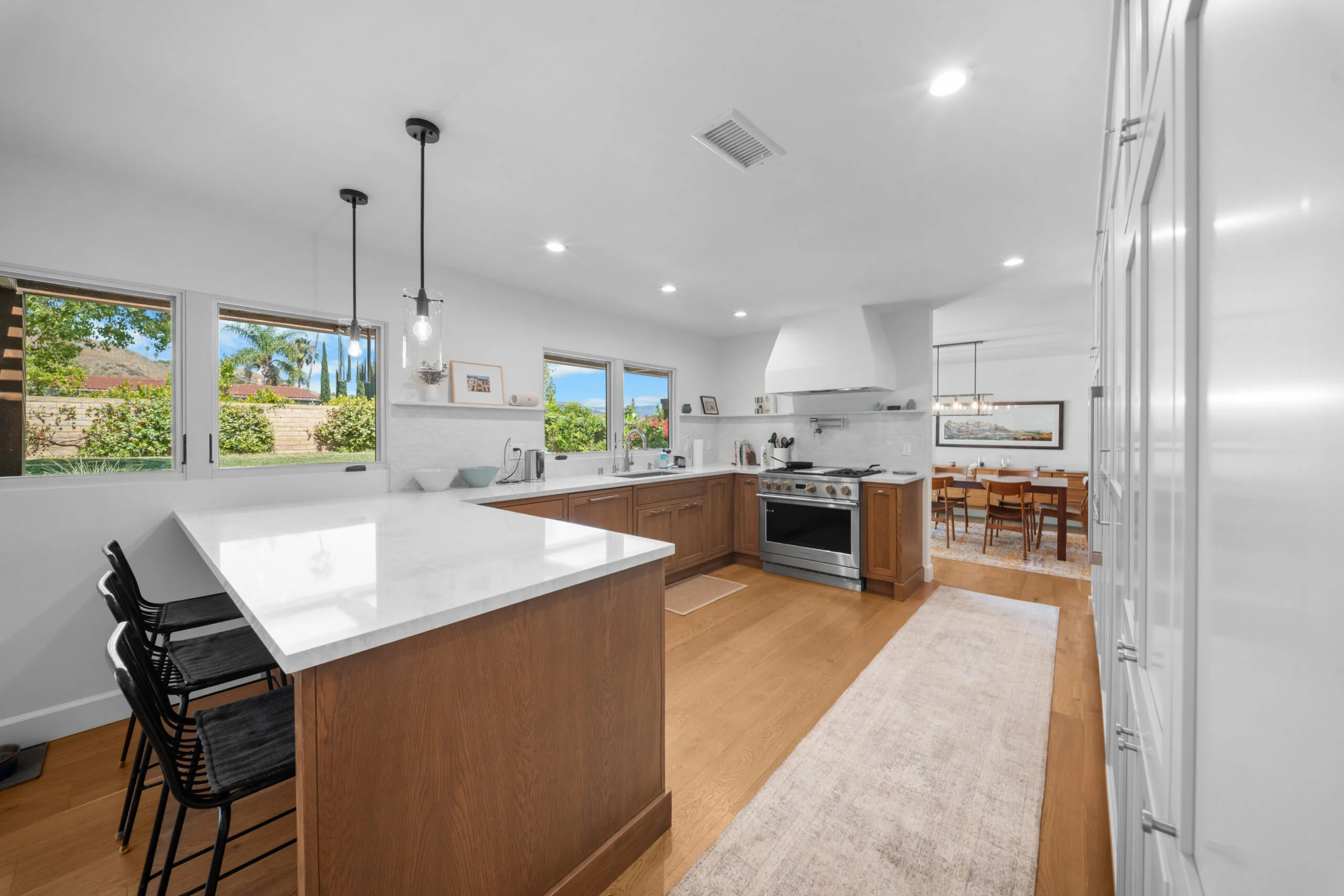
Your GC coordinates design, engineering, and permitting. On a typical LA kitchen remodel that means: measuring the existing space, developing plans and structural details, submitting to the city for permits, ordering long-lead materials (cabinets take 4-8 weeks), and locking down every subcontractor’s schedule so the trades hit the site in the right order.
During Construction
Daily site supervision, coordinating what trade shows up when, catching quality issues before they get covered up, ordering materials as needed, handling change requests from the homeowner, calling city inspections, and keeping the project on schedule. On a 12-week kitchen remodel that’s roughly 60 unique subcontractor visits your GC schedules and quality-checks.
Closeout
Final inspections, punch list resolution, final walkthrough with the homeowner, warranty documentation, and standing behind the work – typically 1 year on labor and workmanship, with individual manufacturer warranties on installed products.
Projects Covered By General Contractor Services
For a residential design-build contractor like RnD Builders, that means: kitchen remodeling, bathroom remodeling, home additions, ADUs and garage conversions, custom homes, exterior remodeling, and outdoor living projects including pools and patios.
How General Contractors Charge in 2026
Most residential GCs price one of two ways: a fixed bid (one number for a defined scope – what we use) or cost-plus (actual costs plus a 10–20% management fee). Fixed bids protect you from drift; cost-plus suits projects where the scope genuinely can’t be defined upfront. Either way, expect contractor overhead and profit to represent roughly 15–25% of project cost – that’s what buys the coordination, accountability and warranty.
Fixed Bid (Lump Sum)
One number for a defined scope. Best when your plans and material selections are finalized. Predictable, and the contractor absorbs cost overruns on the agreed scope. Requires tight specs upfront – any missing detail becomes a change order at markup.
Cost-Plus (Fee or Percentage)
You pay actual costs plus a management fee, typically 10-20%. Transparent, flexible for evolving design, but the final total is variable. Best when finishes are still being selected or the project has unusual complexity that makes fixed pricing impossible.
Time & Materials (T&M)
Rare on residential remodels except for very small jobs or emergency work. You pay for labor hours and materials at a marked-up rate. Predictable only for scoped work; unpredictable for anything discovery-based.
What General Contractor Services Don’t Include
Knowing what’s outside a GC’s scope helps you avoid friction:
- Interior design and material selection at showroom level. Most GCs coordinate design but don’t make style choices. Design-build firms are the exception.
- Landscape design and installation. Usually a separate landscape contractor unless the GC has that specialty in-house.
- Furniture and staging. That’s your designer or you.
- Financing the project. A legit contractor won’t pressure you into financing arrangements – that’s a red flag.
- Owner-builder permits. Be wary of any contractor who asks you to pull the permit as owner-builder for their work. That shifts liability onto you and is a classic red flag we see used by unlicensed operators.
How to Verify a California Contractor
- License: look up the contractor on the CSLB website (cslb.ca.gov). For whole-home projects you want a B – General Building license. Verify it’s active and bond/workers’ comp are current.
- Insurance: ask for certificates of general liability and workers’ compensation naming you as certificate holder.
- Local work: ask for completed projects in your city – real addresses, real photos, real references. Browse our recent work across LA and Ventura County.
- Contract: California requires a written contract for jobs over $500, with a defined payment schedule. Down payments are capped at $1,000 or 10%, whichever is less.
- Reviews: Google, Yelp, and BBB. A contractor with zero reviews is either brand new or hiding something.
- References: ask for 3 recent clients and call them. Ask specifically about communication, timeline adherence, and how change orders were handled.
Red Flags: Contractors to Avoid
- No physical business address, only a cell phone
- Asks for a large deposit (more than 10% or $1,000, whichever is less)
- Cash-only payment terms or no contract
- Pressure to sign immediately or “today only” discounts
- Bid is dramatically lower than others (typically 20%+ below the average)
- Refuses to pull permits or asks you to as owner-builder
- Cannot produce current insurance certificates on request
- License is inactive, suspended, or listed under a different name/entity
What You Get With a Design-Build Firm vs a Traditional GC
The two most common construction delivery models:
Traditional General Contractor
Homeowner hires an architect first, gets plans, then bids the project to multiple GCs. The GC builds what someone else drew. Multiple contracts, multiple handoffs, and any coordination gaps between design and construction become your problem.
Design-Build Firm
One firm owns architecture, engineering, and construction under a single contract. Fewer handoffs, faster timelines, better cost accountability during design (since the same team is building it), and one throat to choke if something goes wrong. Best for whole-home remodels, additions, custom homes, and complex ADUs where design and construction have to move together.
General Contractor FAQs
What’s the difference between a general contractor and a design-build firm?
A traditional GC builds plans someone else drew. A design-build firm handles architecture, engineering and construction under one contract – fewer handoffs, fewer change orders, one accountable team. See how our process works.
Do I need a general contractor for a small remodel?
For single-trade jobs (just paint, just flooring), no. The moment a project involves multiple trades, permits or structural work – kitchens, baths, additions, ADUs – a GC saves more in avoided mistakes and schedule slippage than they cost.
Does the contractor or the homeowner pull permits?
The contractor should – and be wary of any contractor who asks you to pull an owner-builder permit for their work. It shifts liability onto you and is a classic red flag.
How much does a general contractor charge for overhead?
Residential GCs typically build in 15-25% overhead and profit on top of hard costs. That covers project management, insurance, warranty, office costs, and the profit that keeps the business viable. Contractors quoting materially below 15% overhead are either running a short-lived business model or hiding costs in inflated line items.
What questions should I ask before hiring a contractor?
Five questions that filter out the wrong contractors fast: (1) Show me your current CSLB license and insurance certificates. (2) Show me three projects like mine you completed in the last year. (3) How do you price change orders? (4) Who is my day-to-day point of contact – and how quickly do you respond? (5) What warranty do you offer on labor and workmanship?
How long does it take to get a bid from a general contractor?
A rough estimate: 1-3 days after site visit. A firm bid with itemized scope and materials: 2-4 weeks. Contractors who bid a whole-home remodel same-day are either winging it or planning to make up the difference in change orders.
Work With a Licensed Design-Build Team
RnD Builders Inc is a California-licensed (B) general contractor and design-build firm with 300+ completed projects across Los Angeles and Ventura County.
Request a free estimate or call (805) 367-1965.
How To Verify General Contractor Services
- California CSLB license lookup: cslb.ca.gov
- NAHB contractor resources: nahb.org
From planning to permits, one licensed team handling every phase across Woodland Hills, Calabasas, Los Angeles, and Ventura County.


